The acquisition team that reads every document.
Drop the rent roll, T-12, and offering memo. 31 AI roles read them, fill the deal record, flag what needs your eye, and hand you an investment-committee package, with the source row behind every number.
Prove it in one command, npm run proof, then trace one fact from upload to IC package.
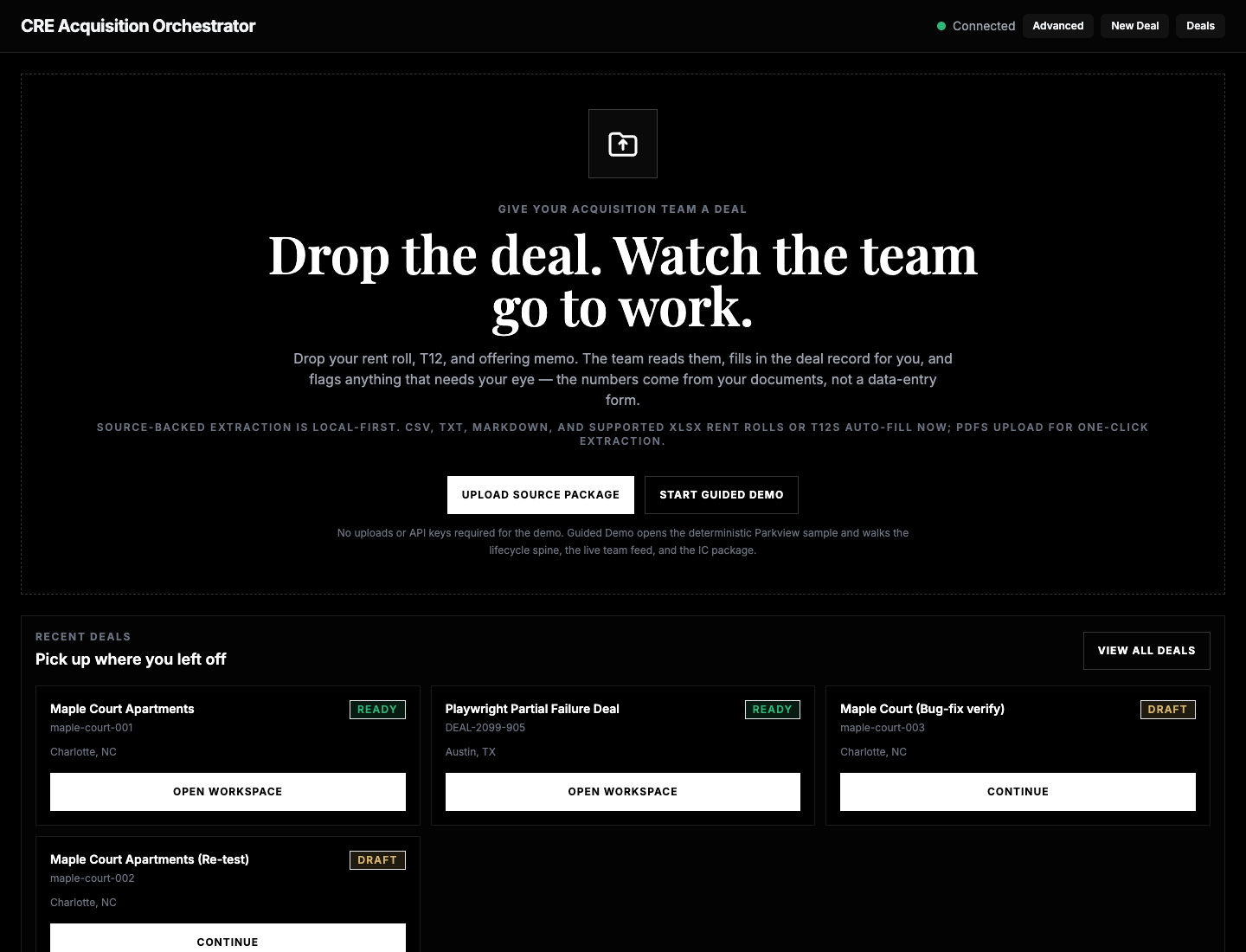
Four moves, one acquisition package.
The category barely exists. Coding agents, support agents, research agents, all common. A framework that models how a real multifamily deal moves across due diligence, underwriting, financing, legal, and closing while preserving handoffs, review gates, and IC evidence? That's this.
Drop your documents
Rent rolls, T-12s, offering memos, PDFs. They land in a local workspace: XLSX, CSV, TXT, MD, text-based PDFs, even readable scanned/image-only PDFs via OCR.
Document-first intakeNumbers come from sources
Every candidate field carries confidence, warnings, a file hash, and its source location: sheet/row/column or page. OCR-derived fields stay review-gated before they can move a single input.
Source-backed extraction31 roles go to work
Six orchestrators direct 25 specialists across diligence, underwriting, financing, legal, and closing. Live ChatGPT/Codex (web search on) pulls and cites real comps, rents, cap rates, and rates.
Visible coordinationApprove, then export
Underwriting inputs don't change until you approve trusted fields or waive ambiguous ones. Export a Markdown/JSON IC starter package, every figure traceable to the row it came from.
Human approval gateProvenance, not a data-entry form.
Click a value and walk backward: approved evidence → the extracted candidate → the exact source row in the file you uploaded, hash and all. No black box between a document and a decision.
- Uploaded-data inspector: tables, field types, fill rates, source rows
- Confidence scores, warnings, and file hashes on every field
- OCR-derived values stay gated until a human approves them
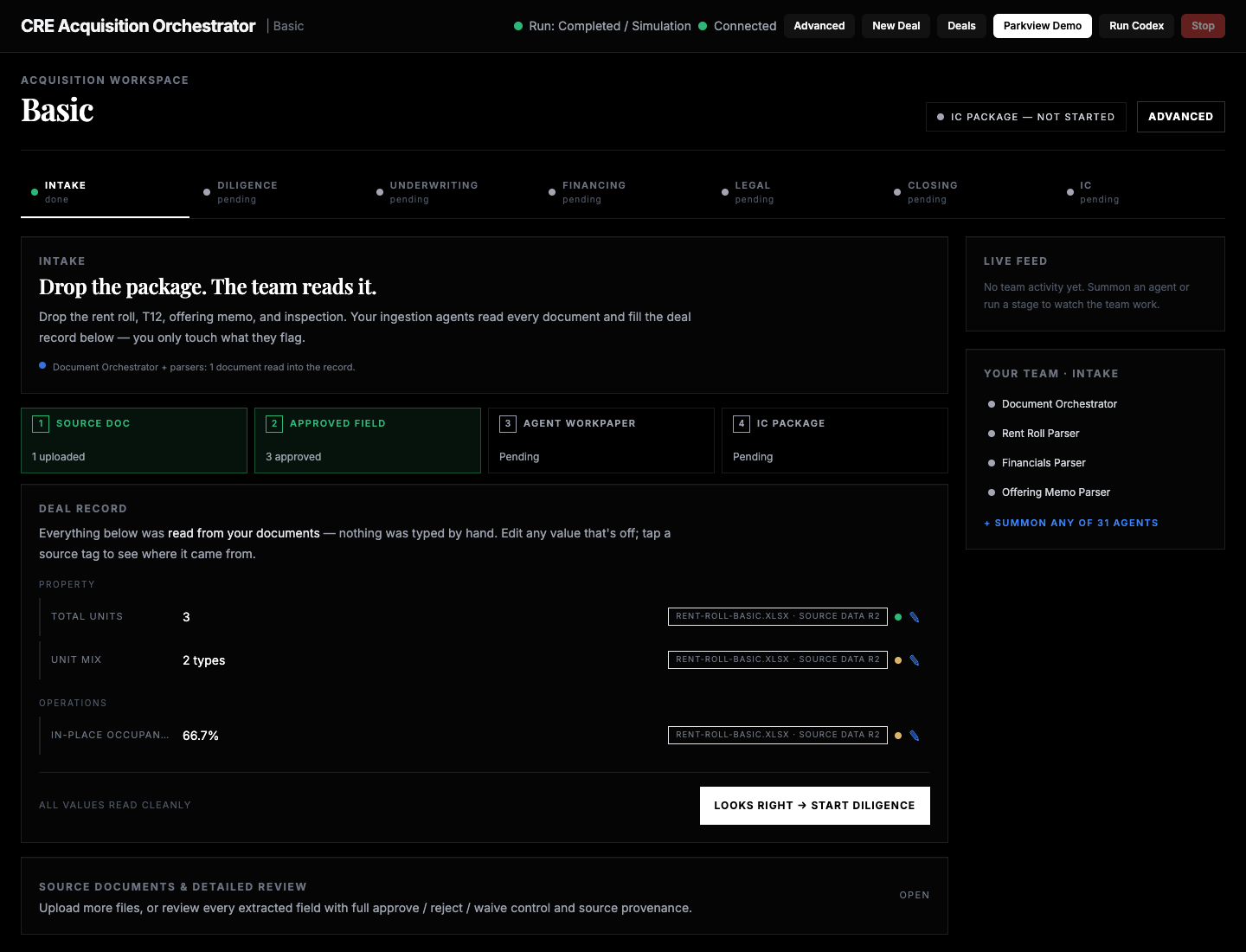
Watch the handoffs happen.
The dashboard streams specialist messages, dependencies, reviews, workpapers, and package status as the deal moves. You're not waiting on a spinner. You're watching a team work, and you can stop it at any gate.
- Live feed of messages, handoffs, and review gates
- Workflow Launcher & Swarm Goal Console default to Codex
- Deterministic offline demo for tours, screenshots, and CI
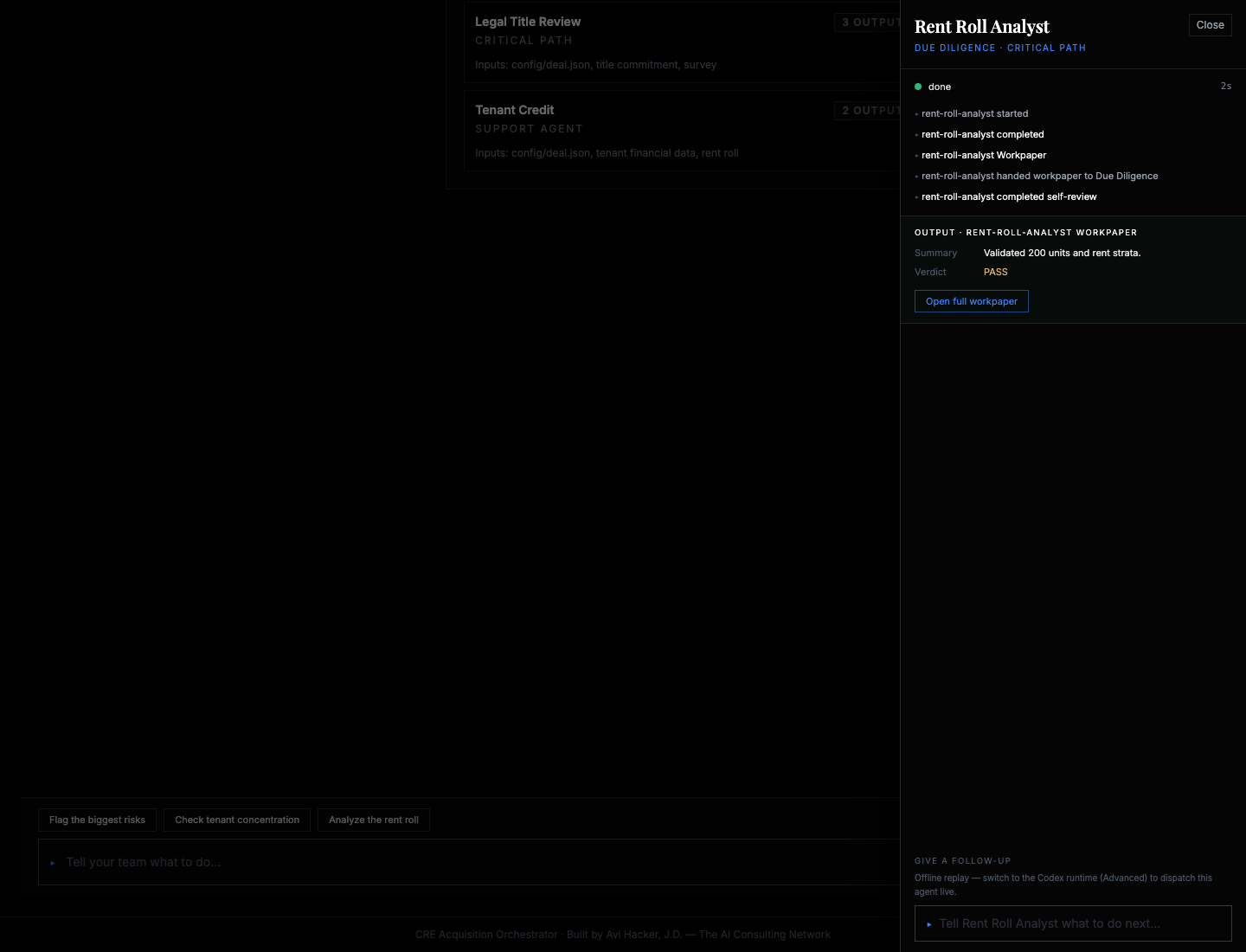
31 named roles. 6 orchestrators, 21 specialists, 4 on ingestion.
Each role is a markdown prompt with defined inputs, outputs, and dependencies, not a vague "agent." Fork them, rewrite them, point them at your own thesis.
- Master Orchestrator
- Due-Diligence Orchestrator
- Underwriting Orchestrator
- Financing Orchestrator
- Legal Orchestrator
- Closing Orchestrator
- Document Orchestrator
- Rent-Roll Parser
- Financials Parser
- Offering-Memo Parser
- Rent-Roll Analyst
- OpEx Analyst
- Physical Inspection
- Tenant Credit
- Market Study
- Environmental Review
- Legal & Title Review
- Financial Model Builder
- Scenario Analyst
- IC Memo Writer
- Lender Outreach
- Quote Comparator
- Term-Sheet Builder
- PSA Reviewer
- Title & Survey Reviewer
- Estoppel Tracker
- Loan-Doc Reviewer
- Insurance Coordinator
- Transfer-Doc Preparer
- Closing Coordinator
- Funds-Flow Manager
Inputs, outputs, dependencies, and the markdown prompt behind every role.
Agent catalog →Architecture isn't accuracy. So we score ourselves, and publish where we fall short.
An open evaluation harness scores the orchestrator on 8 synthetic deals with committed ground truth, fixed before the run. Nothing is tuned to flatter. Run it yourself: npm run eval
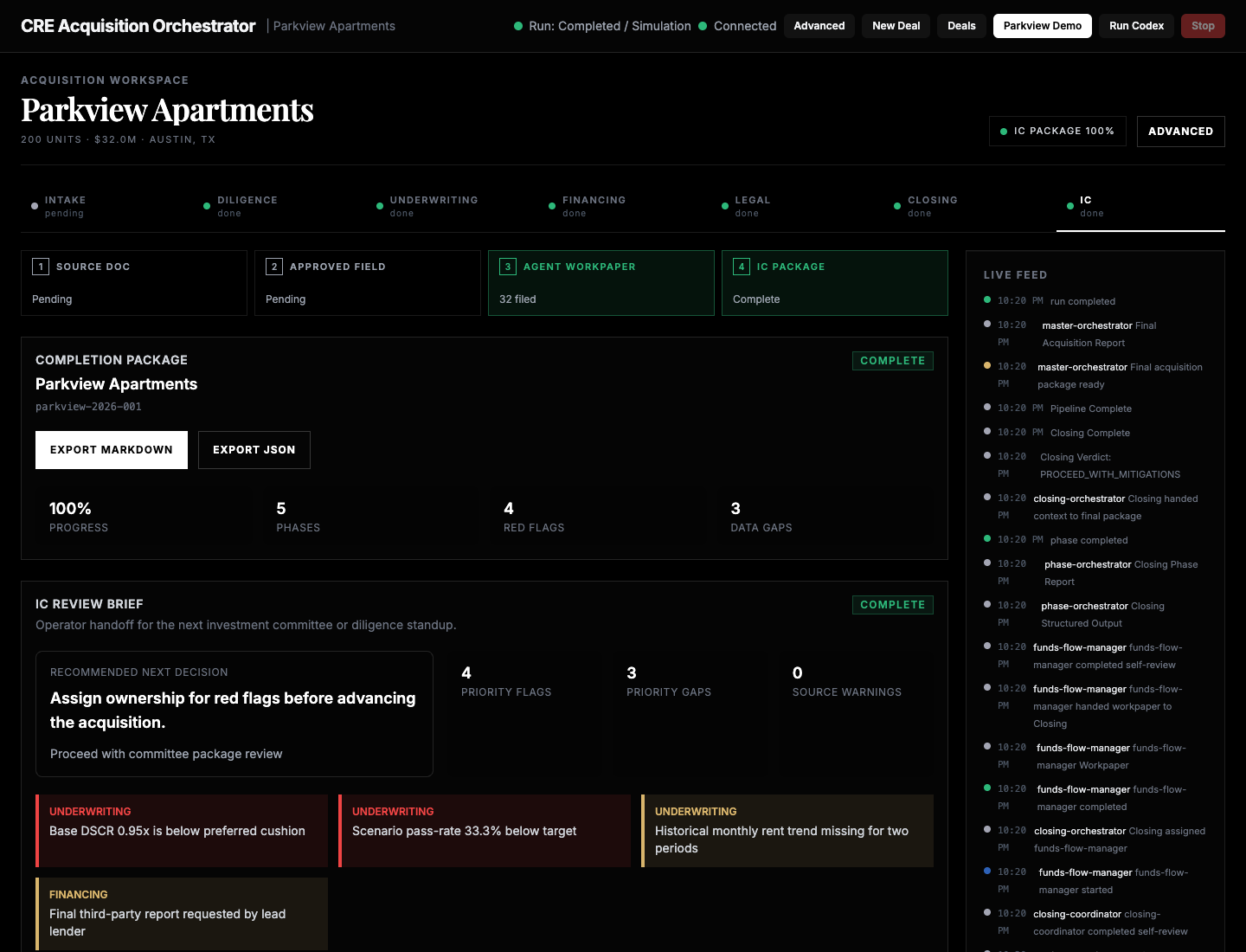
An IC starter package you can defend.
The team's output isn't a chat log. It's a structured investment-committee package: workpapers, findings, a decision log, and a verdict, every figure linked back to the source it came from. Export Markdown and JSON and walk it into the room.
- Workpapers with cited evidence and source locations
- Decision log and IC verdict with the reasoning behind it
- Markdown + JSON export, ready for your own templates
Open source, local-first, and honest about its limits.
The agent prompts, domain skills, schemas, pipeline, dashboard, and demo artifacts are all here: a starting point, not a locked product. Fork it. Adapt it to your deals, your thesis, your internal workflow.
Local-first by default
Run the full proof path with no API keys. Inspect tables, review fields, approve or waive, and export an IC package, and nothing leaves your machine until you choose to send a deal to Codex.
Two runtimes, one frame
Live ChatGPT-authenticated Codex with web search is the default workflow runtime; an explicit deterministic offline simulation stays the no-credential fallback for demos, screenshots, and CI-safe validation.
Evidence over vibes
Confidence, warnings, hashes, and source locations on every extracted field. Human approval gates stand between any document and your underwriting inputs.
Inspectable internals
31 markdown role prompts, 27 JSON Schema contracts, 5 workflow definitions, 8 domain knowledge files, and 40 curated fixtures, all in the open, all version-controlled.
A category that barely exists
Plenty of agent frameworks for code, support, and research. Almost nothing that models a real multifamily acquisition end-to-end. This is the most in-depth open framework for it we've seen.
Apache 2.0
Permissively licensed and built in public: TypeScript 5.7, React 18, Node 18+. A reference architecture and educational framework, not investment advice.
Frequently asked.
What is the CRE Acquisition Orchestrator?
It's an open-source, multi-orchestrator workspace for commercial real estate multifamily acquisitions. You drop documents — a rent roll, T-12, and offering memo — state a goal, and 31 AI roles coordinate across due diligence, underwriting, financing, legal, and closing to produce a source-backed investment-committee package.
Is it free and open source?
Yes. It's released under the Apache 2.0 license and is free to use, fork, and adapt. The full source — agent prompts, JSON schemas, the pipeline, the dashboard, and demo artifacts — is on GitHub.
Do I need API keys to try it?
No. The local-first proof path runs with no API keys: inspect uploaded tables, review extracted fields, approve or waive them, and export an IC package entirely on your own machine. Live ChatGPT/Codex with web search is an optional runtime for pulling real market data.
How does it keep the numbers accurate?
Every extracted field carries a confidence score, warnings, a file hash, and its exact source location (sheet/row/column or page). Underwriting inputs don't change until a human approves trusted fields or waives ambiguous ones — so every figure traces back to the document it came from.
What are the 31 AI roles?
Six orchestrators direct 25 specialists: 4 document-ingestion roles, 7 in due diligence, 3 in underwriting, 3 in financing, 6 in legal, and 2 in closing. Each role is a markdown prompt with defined inputs, outputs, and dependencies.
How is its accuracy evaluated?
An open evaluation harness scores it on 8 synthetic deals with committed ground truth. The live agent layer reaches 100% narrative red-flag recall, 100% dealbreaker recall, and 100% determinable-financial accuracy, with an 88% exact IC-verdict match — and the report publishes where it falls short, such as model-dependent returns at 50%.
Bring the acquisition workflow into the future.
Clone it, run the proof path in ten minutes, and trace one source-backed fact from upload to IC package. If it helps even one team rethink how they approach deals, open-sourcing it was worth it.